
The 10 Most Used Motorcycle Anti-Theft Devices of 2026
No one wants to suffer the theft of something they own, regardless of the economic or sentimental value that object has. However, there are people who have built a career as professional thieves by appropriating others' property, and it is right to seek the best way to keep these individuals away from our belongings. We have discussed this extensively in this article on the most stolen motorcycle models in Italy.
Regarding two-wheeled vehicles - essential in everyday life and an expression of our passion for freedom and travel - we have several alternatives that guarantee security at different levels and depending on the spending capacity.
Before listing, however, it is necessary to distinguish between active security and passive security: in the first case, these are systems that prevent theft, so everything - mechanical or electronic - that can make the thief think it is too difficult to continue and makes them give up on completing the theft.
Regarding passive security, these are electronic systems that help us find the motorcycle that has been stolen and therefore increase the chances of bringing it back home as soon as possible. Let's get started.
1. STEERING LOCK ★☆☆☆☆
Standard on almost all motorcycles, it is the basic security system that keeps the handlebar in a folded position and prevents the motorcycle from going straight, but not from being moved. Security is low because in most cases it can be easily disabled with a well-placed kick that breaks the lock (which is generally fixed on the steering stem) and frees the movement again, making the motorcycle immediately transportable.
| PROS | can waste thieves' time |
| CONS | easy to disable |
2. KEYLESS SYSTEMS WITH ELECTRONIC STEERING LOCK ★★☆☆☆

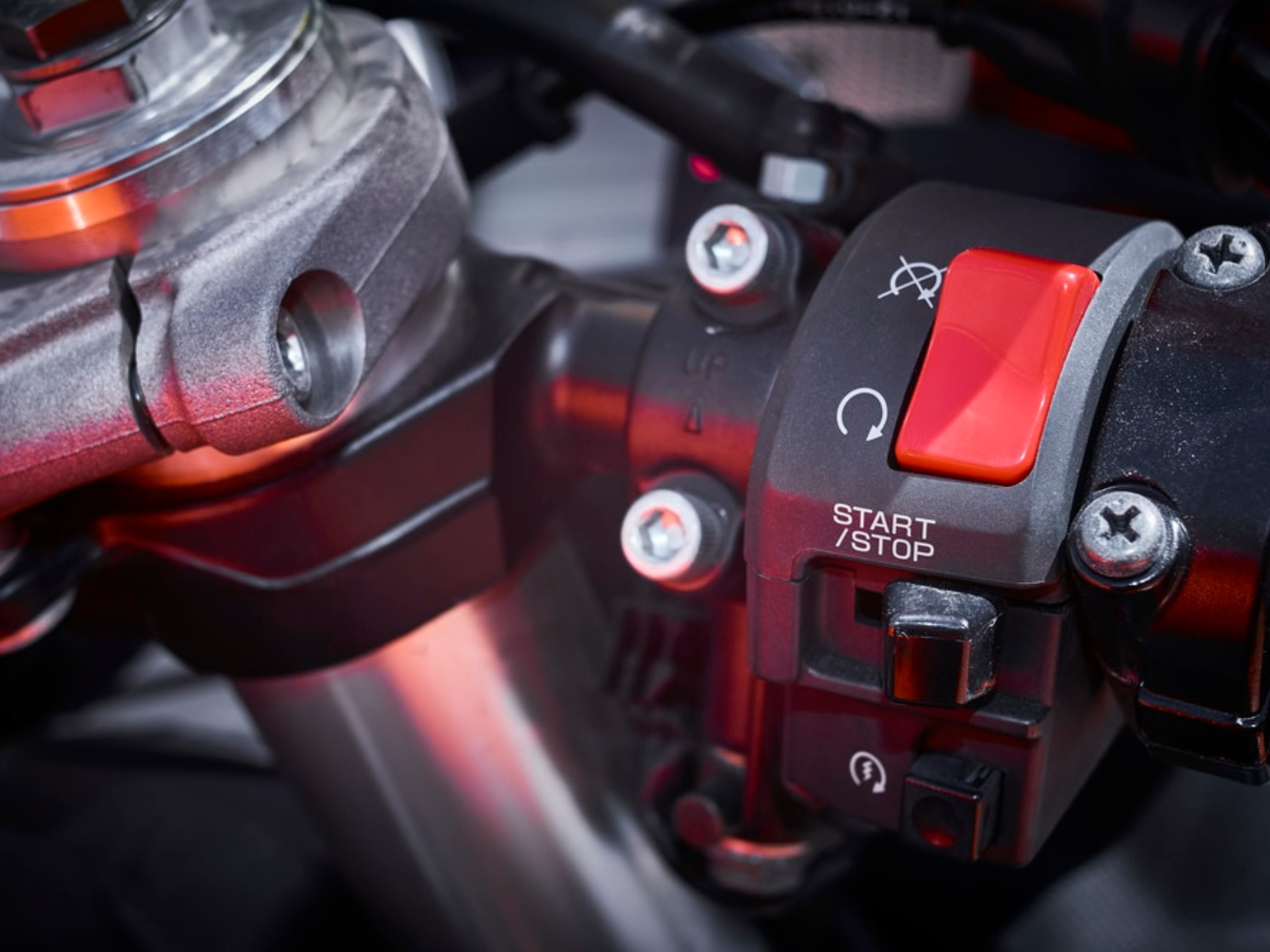
Recently, many production motorcycles are equipped with keyless start systems that allow the motorcycle to start without a key but via a button, which communicates with the motorcycle through a transponder. In these cases, the steering lock is electronic and engaged by an electric actuator.
Although it does not have a key and is therefore impossible to break into, this system can be bypassed with specific electronic devices that intercept the key's signal and simulate it by approaching the motorcycle.
| PROS | Non-professional thieves do not know how to break into a motorcycle without a key |
| CONS | organized thieves have the tools to simulate the key and leave with the motorcycle undisturbed as if it were theirs |
3. IMMOBILIZER ★★☆☆☆

The immobilizer is also a standard security system on many motorcycles and scooters, especially models produced from the 2000s onward. It is basically a system that connects an antenna in the motorcycle with the receiver embedded in the key, identified by a code. When the antenna does not communicate, the engine will not start even if a cloned key is used in the ignition.
| PROS | inexperienced thieves might not be able to unlock the system |
| CONS | the motorcycle can still be moved and taken away if no other security systems are installed |
4. CHAIN ★★★★☆

The classic padlock is the simplest, oldest, and most logical security system, yet it remains one of the most effective in terms of active security. Of course, you need to know how to use it properly, because incorrect placement or a very low-quality chain can make the system as insecure as a steering lock.
To earn four stars, it must be a heavy, high-quality chain with a strong, hard-to-break padlock that can securely anchor the motorcycle to an urban furniture element like a railing or post.
The downside is that—for the most secure locks—they are heavy and bulky objects that can be very inconvenient to carry and can cost several hundred euros. Some chains also have an alarm that triggers a siren when tampered with, which is a significant plus.
| PROS | high security for a top-of-the-line chain |
| CONS | large size, weight, and high price for the most secure models |
5. D-LOCK ★★★☆☆

Very similar to the chain, the D-lock (or "U-lock," or "ring lock") is installed on the wheel of a motorcycle or scooter to block rotation, or it is used to secure the vehicle to a post or other urban furniture elements.
Here too, the security level is high due to the nature of the system: it is a rigid post, bent into a U shape and locked at both ends with a sturdy padlock that is hard to break. The downside is definitely the system's low mobility, which in the most secure versions is bulky and cannot be folded for transport.
| PROS | high resistance to tampering |
| CONS | bulky, heavy, and cannot be folded |
6. BRAKE LOCK ★★☆☆☆

The brake lock is a padlock system that locks the throttle grip and pulls the front brake lever, making the motorcycle difficult to move. The system works to waste thieves' time, but being - logically - small in size, it offers limited resistance to tampering.
It is a relatively inexpensive object, lightweight and easy to carry in a backpack or store under the seat, so it can be useful if used together with other more efficient systems.
| PROS | convenient and compact |
| CONS | not very secure even though it wastes thieves' time |
7. DISC LOCK ★★☆☆☆

The same applies to the disc lock as to the brake lock; it is very useful to make the thief lose a bit more time but is not top in efficiency. Neutralizing a disc lock (even larger and high-quality ones) can be easy.
The thief can take just a few minutes if they have a set of keys that allow the disc to be removed, generally screwed with 5 or 6 simple Allen screws on almost all motorcycles and scooters, detaching it from the wheel and freeing the vehicle's movement. There are also versions with acoustic alarms that add an extra layer of security.
| PROS | easy to carry and install |
| CONS | easily neutralized by removing the disc |
8. EASYBLOCK ★★★★☆

This accessory has a logic similar to the disc lock because here too the rotation of the (rear) wheel is mechanically blocked, but it works in a very different way that greatly increases security.
It is a system that is fixedly anchored to the scooter's crankcase or the motorcycle's swingarm, thus becoming part of the vehicle's hardware and does not need to be mounted and dismounted every time, only activated with the key.
A pin blocks the rotation of the wheel (on scooters) or the sprocket (on motorcycles) and, being made with special iron and steel alloys, it is difficult to neutralize quickly and quietly. It is available for many scooters and motorcycles on the market (including the most stolen ones in Italy) and offers an excellent quality/price ratio.
| PROS | Very secure, once installed on the motorcycle it does not need to be carried |
| CONS | the motorcycle can still be lifted and taken away |
9. SOUND ALARM ★★★☆☆

Acoustic alarms are also fundamental to the concept of anti-theft. Whether for cars, motorcycles, or homes, a sensor that detects unusual movements activates a siren which - due to its high volume - attracts the attention of those nearby and deters the thief from continuing their dirty work.
The deterrent effect of a very loud sound has always worked, but in an isolated context it is not enough to discourage the thief and very often it is easy to neutralize the effect by breaking the speaker or disconnecting the vehicle’s battery. Also, in cities, with all the alarms going off, it’s easy to ignore such a warning.
| PROS | noisy, scares off thieves |
| CONS | unfortunately, alarm sirens are increasingly ignored |
10. SATELLITE ALARM / GPS TRACKER ★★★☆☆

This is a passive system, meaning it can track the stolen motorcycle via satellite connection, showing the route the motorcycle is taking in real time and where it is at every single moment.
Most of the time it is also connected to your phone number and sends a message or call when activated to alert you of the attempted theft. There are also downsides here related to advancing technology.
Thieves are increasingly discovering methods to cancel the signal by tampering with the motorcycle or covering it with shielded blankets that block the signal to the satellite, quickly losing the trail.
| PROS | allows you to monitor the vehicle’s location |
| CONS | does not prevent theft and the signal can be neutralized |
HOW DO I CHOOSE THE RIGHT SYSTEM FOR ME?

The market offers many solutions; just visit a motorcycle accessories dealer or browse the internet and it’s easy to get lost among the dozens of offers, the wide price range, and the different types of anti-theft devices available.
Identify how you use the motorcycle, where you usually park it, and whether you keep it every night in a private and closed place or in a place where strangers also pass by. Based on the level of security and peace of mind that "basically" surrounds the vehicle, act accordingly.
One very important detail, however, you must keep in mind: safety and convenience go in opposite directions, and to have a maximally secure motorcycle you will have to sacrifice some practicality each time by using multiple security systems that take time to install and remove, as well as space for transport, except for electronic systems and Easyblock which do not need to be removed from the motorcycle.
To get a more complete understanding of motorcycle theft and useful tips on how to prevent it, also check out our complete guide to motorcycle safety.
